- And Now What?
- Posts
- No, thanks, Julius Caesar. I’ll start in the real spring.
No, thanks, Julius Caesar. I’ll start in the real spring.
Why January is a terrible time to make big changes.

Stephen Nock
January 20, 2026
On Not Starting
I’m declaring war on Julius Caesar. I’ve long been a bit of an anti-New Years person. There might be a small piece of me that simply likes to be different, but I also have strong justification.
I’ve asked myself questions like:
Does happiness come from within us or from the world around us, from a calendar and clock?
Why do so many people think now is the time to make changes?
“Here’s my prediction: at the end of 2019, we’re going to chalk it up to a wash and say “thank God, 2020 is here! Now we can start transforming ourselves.” Why bother, if we know it’s going to be regrettable?” This one aged really well…
More recently, I’ve been wondering where do we think we’ll find the energy for individual and collective transformation (a) after the stress of December and (b) in the dead of the northern-hemisphere winter?
I was delighted to stumble upon this seemingly well-researched Substack post summarizing the history of the calendar we use today. If you are one of the many folks affected by the annual “circling back” parade and find yourself with not-enough time to read it all, here’s my summary:
January and February were added to the calendar around the year 700 BCE (ie 2700 years ago…), but this was followed by many centuries of chaotic, differing opinions about when the year should start. It wasn’t until Caesar declared in 46 BCE that January 1 became the start of the year. It only took another 1700 years before protestant cultures like the UK and the USA finally acquiesced to the Gregorian calendar, in 1752.
You see why I felt validated by discovering this? (Isn’t it so nice to prove that I’m right!? Sounds like a great coaching moment, honestly… ) I’m not even alone in this thinking! There has long been resistance to January 1. It took some 2400 years for a big portion of the world to agree to start the year in January, and I’m ready to re-open the argument.
Sure, it’s probably nice to get the boost of “okay, let’s get going,” but change requires pain, motivation, and a high amount of energy. Are you really ready to step outside of your comfort zone and develop new, sustainably practiced habits on the first of January? I’m certainly not. Various studies give us evidence that 70-80% of January goals and resolutions fail.
And yet, we try and try again, thinking that we’ll be the outlier, the one who will start writing a book the day after New Years Eve. When the sun rises later than ever, you’re going to spring out of bed and hit the gym before work 4 days out of 5. You’re going to sprint for the raise or the promotion two weeks before the cycle ends, knowing they’ll only give raises to 2% of the top performers and those will be pushed out to the mid-year review. Who are we kidding? Let’s go back to bed!
 Does this look like a time for running or for rest? | 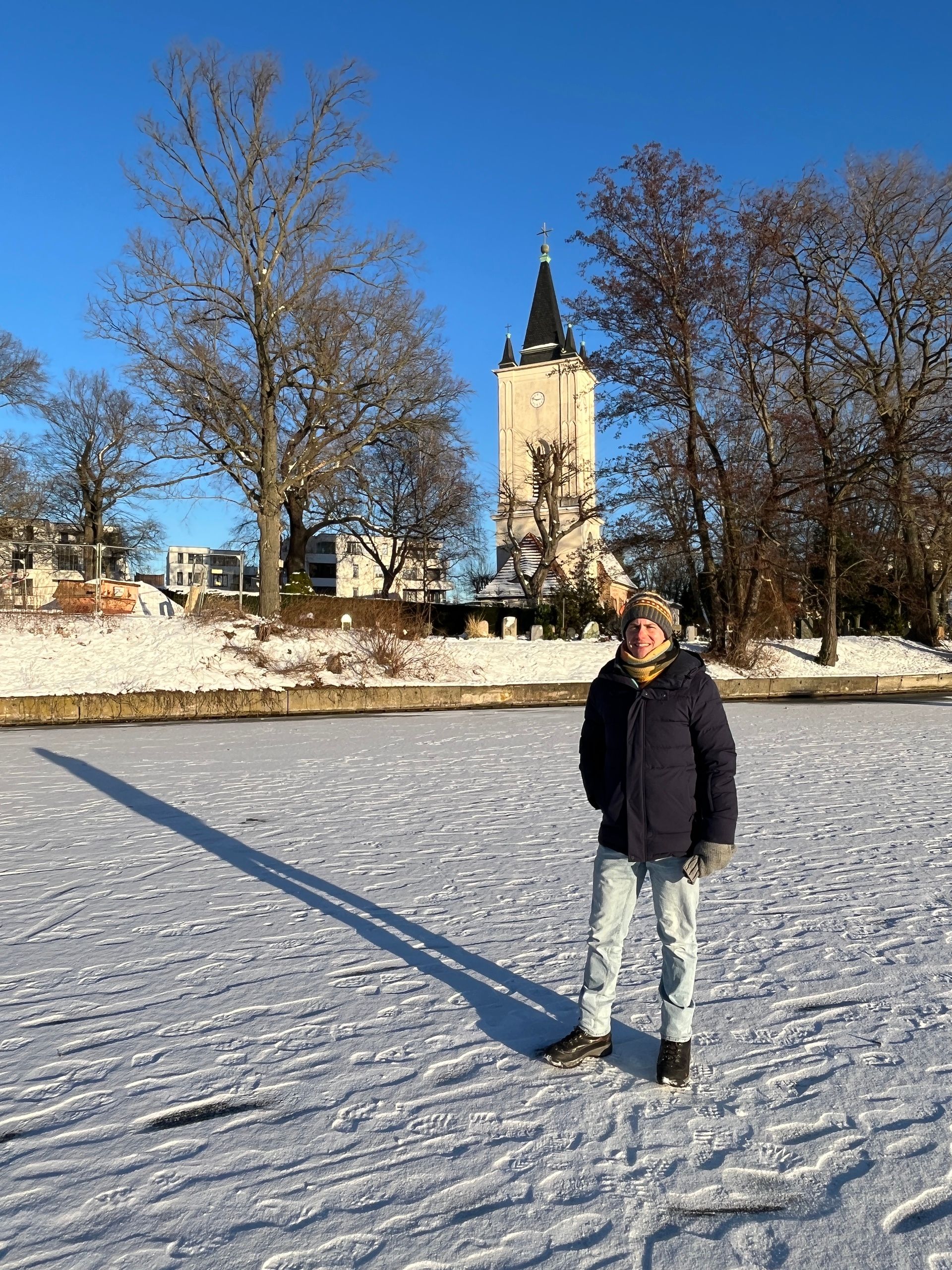 The world is not moving so fluidly. I’m standing on ice. |
As different countries and cultures eventually congregated around January 1, those who celebrated New Year's Day on January First made fun of those who celebrated on other dates by the invention of April Fools. I hope you’ll take me seriously and recognize that just because Julius Caesar thought it was a good idea, you don’t have to hit the ground running. Join me in being an April Fool and starting the year (yes, we’re still in “starting” mode) with a walk and some active rest. Next month, maybe we can pick up the pace to a jog, and come spring, we can start running together.
What am I encouraging you to consider and rethink?
Give yourself time to reflect and consider what change you desire.
Make your own choice about when to initiate change (but don’t wait until you’re ready, because you’ll never be ready… hard, I know.)
Know what energy, resources, and practices are going to support you to sustain.
Take it easy in January and February. I’m not suggesting to be lazy and aim for 0 productivity. I’m inviting you to lower the bar, start slow, build up toward the bigger lifts, and walk before you chase your new PR.
Have you set some kind of new years resolutions? (Maybe you don’t call them that, but you initiated something in the last few weeks, hoping for a long-term impact.)
If you’re noticing you’re already at risk of falling off course (or worse, gone!), maybe it’s not you. Maybe it’s not time to write off 2026. (It’s an abstract container of time in the first place!) Maybe your goals and 2026 plans need a combination of different strategies and different timing.
Take your time.
And What Else?
Explore these questions, and embrace the challenge to dig deeper, asking what else might be relevant to answer.
Honor Yourself: What do you feel a bit of shame or guilt for not continuing or completing?
Explore Curiously: What are some things that get in the way and cause you to lose momentum?
Foster Trust: What helps you stay on track with your goals?
Shift Perspectives: What can you give yourself permission to stop, restart, or not start?
Clarify Decisions: What would you like to schedule for spring?
Empower Action: What’s a (lower) bar that you know you can still achieve this winter?
Nuggets of Work-Life
Every coaching session and workshop closes with acknowledging learnings, insights, and moments of celebration. Here are a few of my recent nuggets:
In December, at a gathering with other coaches, I found common ground with other coaches who can see calm and quiet as strengths in our profession. That acknowledgement feels like a win to me!
A few dozen localization professionals joined me to explore their plans for 2026 in a recorded workshop. (Disclaimer! I reminded them that we don’t need to reinvent ourselves just because it’s January.) Mostly, we celebrated and embraced how pausing to plan is a rather radical act in today’s fast-moving world. Want to be radical, too? Catch the 2–hour recorded workshop with guided exercises and worksheets.
With quite a few new clients starting recently, I can proudly say that my calendar is nearly full. I don’t say this with the intention to create a sense of scarcity or to suggest that I can’t take more coaching work. I want to celebrate having enough, and I’m grateful for every one of you.
Practice Makes … Space for More Practice
A pastime: when getting outside doesn’t feel manageable, take a short break and visit a park somewhere else in the world for 60 seconds. Imagine yourself laying in the grass, watching the swingset, or seeing a breeze ripple across a pond. That’s the premise of One Minute Park, which gives you the chance to have a window into someone else’s world. Inhale. Exhale. Reset.
A recipe: One of my favorite salads, which punches with rich flavor in the dead of winter: dice a few beet root (pickled, storebought), slice a few green/spring onions, break a brick of feta cheese into chunks. Season with olive oil, salt, and pepper. Indulge!
A movement: Clasp the hands together, so that the fingers are interlocked, and start to circle the wrists. Play with clockwise, counterclockwise, and figure-eights. How does it feel to notice the tactile sensations in both hands. Switch to alternate which finger and thumb are on top (likely the “awkward” or unnatural way). Repeat the exercise, and notice what feels different.
Ways to Engage and Support
On the topic of the new year and getting started (or not), would you be interested in joining a low-commitment club for starting (slowly!) in spring? If you’re compelled by the idea of waiting to set “new years resolutions”-like commitments until March or April, reply with a simple “I’m curious about the April Fools Club you’re starting.” I’d love to start something - together!
Last month, I started adding free recorded meditation to Insight Timer, which gives you a way to create a few minutes of calm any time, any place. Meditation is a great form of active rest. The current average rating of my meditation recording is 4.5/5. If you’ve got 3-5 minutes to sit with yourself, I’d love to have your review, too.
In joy,
Stephen