- And Now What?
- Posts
- I’ve saved you a seat on the joy train.
I’ve saved you a seat on the joy train.
What would change around you if you felt more joyful?

Stephen Nock
April 21, 2026
Why the name &joy, Stephen?
I’ve never written the story of the name &joy. It’s not like it’s a secret, waiting for National Coming Out Day. It’s just... never been written down. But I think it might be time.
I need not ask you what you think of what’s going on in the world to know that there’s space for more joy in all of our lives. When I asked some of my Instagram community where they’re seeing joy, they answered things like horses, relationships, fruit, reading, sunshine, spring, family. For me lately, it’s colorful flowers. When I asked folks where they see sadness, there was tons of resonance that the news feels sad.
It’s not that the external narrative needs to dictate how we live and think; if anything it’s the opposite. The news can feed us plenty of non-joy, but we can also pre-condition ourselves to see joy. As my coaching holds space for people in many circumstances and stages of life, I choose to remind myself of the possibility - however small - that joy can also be present.
And that’s the point.
There can always be joy.
Sadness and joy.
Fear and joy.
Anger and joy.
Inspiration and joy.
The recent lunar mission amplified the visibility of joy in my orbit, as the mission control correspondents coined the term “moon joy”.
Upon return to Earth, the Canadian astronaut Jeremy Hansen elaborated on the crew’s invention of the joy train: “we’re not always on the joy train, but we’re committed to getting back on the joy train as soon as we can.”
Note the first part: we’re not always on the joy train. I’m no stranger to the version of joyfulness that blurs into toxic positivity. If we’re “good vibes only,” we can risk gaslighting or invalidating human experiences like sadness, grief, or anger, often causing guilt, shame, and increased emotional distress instead of comfort. That’s not what this is about.
No emotion is mutually exclusive.
Disney-Pixar’s Inside Out creatively teaches us about the need for emotional balance. Sadness, Anger, Fear, and Disgust play alongside Joy, the energetic leader who ensures young Riley is happy and seeks to view challenges optimistically. As Riley matures into teenage years, the sequel adds Anxiety, Ennui, Embarrassment, Envy, and Nostalgia. Yet Joy persists as a main character.
Not all of us can go to the moon to chase joy, but I do think it’s worth exploring where joy wants to have a little more main character energy in our lives.
If you’re feeling sad, afraid, overwhelmed, lost, confused, or anything else, I want &joy to be a reminder that you, too, have the agency to choose joy. If you’ve lost the agency, I want &joy to be a possibility of rediscovering the possibility of joy. We start where we are.
How soon is the right time to get back on the joy train? When you notice yourself missing joy, can you commit to recovering joy as soon as you can? Next time you notice you’re not on the joy train, will you look for a chance to get back on? I’ll save you a seat.

And What Else?
Explore one or all of these questions, and embrace the challenge to dig deeper, asking what else might be relevant to answer.
 |
|
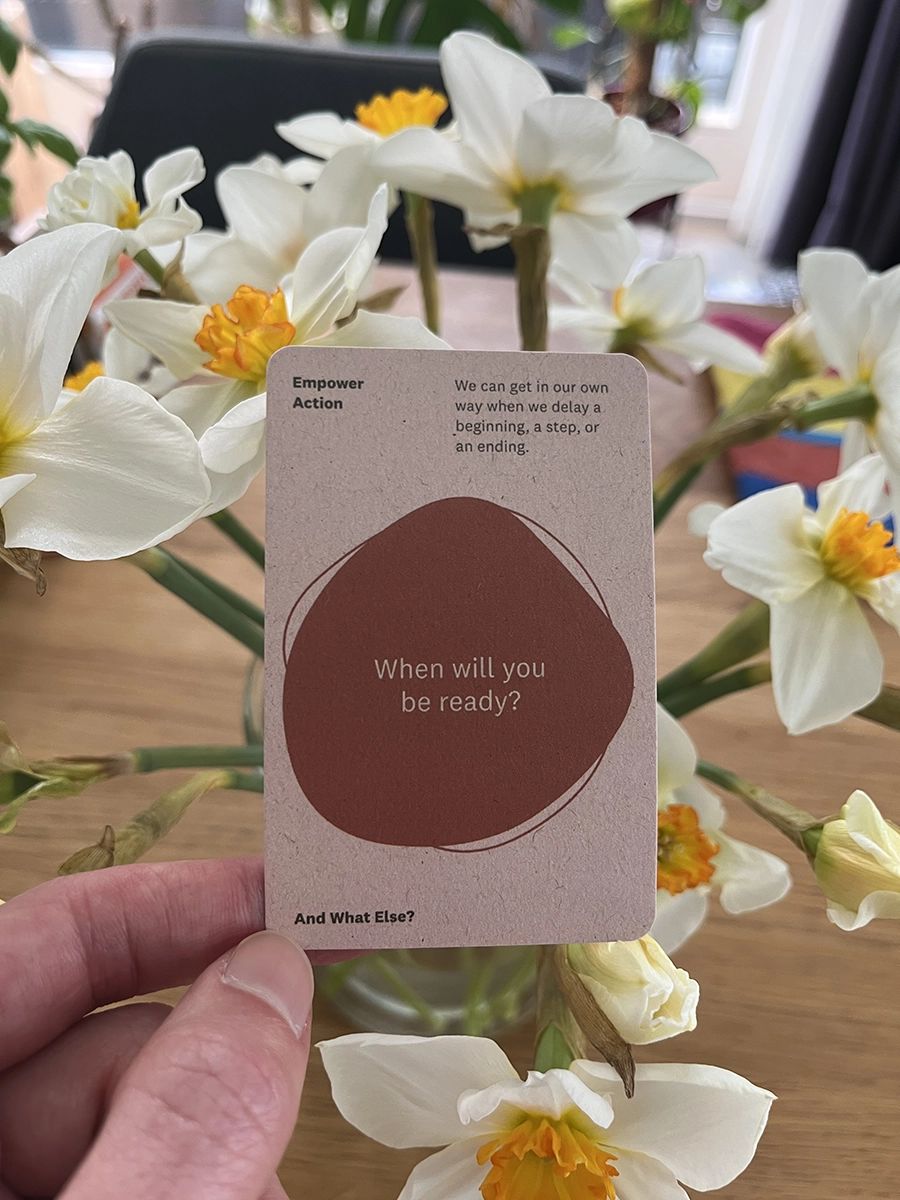
These questions match the categories of the And What Else? coaching card deck, which will be available for purchase soon. (My second real-life product!? I don’t think I’m fully noticing this.) Each card fits one category and invites you to explore a question in 4 layers. Stay tuned!
Nuggets of Work-Life
Every coaching session and team workshop closes with acknowledging learnings, insights, and moments of celebration. Here are a few of my recent nuggets:
While most, but definitely not all, of my clients lean technical in their interests, I’ve recently coached several engineers with advanced degrees. Digging back to my own engineering degree, I was surprised to realize that not every engineer knows a decision matrix. If you’re weighing a decision, defining the criteria and ranking the options can be a powerful method to objectively assess emotional uncertainty. Let me know if you want to try it, and I’ll send you a template.
Here are two quotes from some of those technical clients on our coaching journey:
“I am definitely more conscious about my analysis paralysis - it's a skill that I'm going to hold onto for the future.”
“I was afraid maybe the coaching sessions will be useless. It helped me get to the core of the conversations. It gave more structure, and made my decisions less about emotions. I could have been freaking out.”
Personally, I’m really appreciating the value of patience. So many examples in everyday life remind me that “good things take time.” After a few slower weeks in the start of April, I’m back to being nearly fully booked. I’m grateful for the reminder to value the slower moments.
Practice Makes … Space for More Practice
A pastime: Go for a walk. Take only the necessities, e.g. keys, adopting the joy of leaving phones and headphones behind. Just wander and notice what you notice.
A recipe: A last-minute get together with some friends showed me that not all cheese cakes require patience and precision. This Italian-style cheesecake comes together very quickly. Mix 455g ricotta cheese, 120g creme fraiche, 100g sugar, 60g cream, 1 egg, 3 egg yolks, 1 tablespoon lemon zest, 2 teaspoons vanilla extract, and ¼ tsp salt. Pour into a pre-baked pie shell. Bake at 175°C (350°F) for 30 minutes and voila – or rather, ecco! Serve with fresh berries on top.

A movement: Smile. Just do it. You know that saying about how many muscles it takes, so let’s call it a movement.
Ways to Engage and Support
I’m exploring a new way to publicly collect testimonials and feedback. If we’ve worked together, can you leave me a Google review or rating? If you’ve previously left me a testimonial, send me an email, and I’ll be happy to copy/paste your comments for you to repost.
In joy,
Stephen